

So, many of you know that I am dyslexic, but I received intensive help because my mom and my first-grade teacher knew I was in trouble. (I recently realized that my then-teacher used Orton Gillingham curriculum to help me.)
My younger son also is dyslexic, but he didn’t get the same intervention until third grade — three years at the Pilot School which helped significantly. At the same time, where he was entering 6th grade and where I was entering 6th grade — dramatic difference demonstrating the profound impact that early and intense intervention makes a WORLD of difference. And I will never get over my mom guilt for not insisting on more.
Anyway, I came across this article about the non-academic impacts on individuals with dyslexia and significant reading challenges. My summary below doesn’t do the article justice, but if you only read that, then it’s better than nothing.
Key Emotional & Social Impacts
Those who are neurotypical may not realize the amount of mental and physical energy it takes to function each day — especially in an academic setting.
Anxiety: The most common symptom. It often manifests as “avoidance behavior,” which parents and teachers frequently mistake for laziness or apathy.
Anger: Born from chronic frustration. Children may stay passive at school but “explode” at home, where they feel safe enough to vent.
Poor Self-Image: Because success is often seen as “luck” and failure is seen as “stupidity,” many develop a sense of powerlessness that can last into adulthood.
My son experiences all of these things, and it has only intensified since he entered high school. Imagine going to school EVERY DAY thinking you are stupid and can’t do anything right. Thinking you will fail no matter how hard you try, so you try but don’t ask for help, so you don’t do well, so then you spiral even more into the thoughts of failure.
No matter how many times we, his teachers, his doctors, his therapists have told him that he is smart and kind and a problem solver and creative and… he sees himself as the stupid person who can’t read. Of course it isn’t rational, but try going to school every day and trying to read something when you only recognize maybe 70% of the words and the rest of the words look like hieroglyphics.
Here is what 80% reading comprehension looks like:
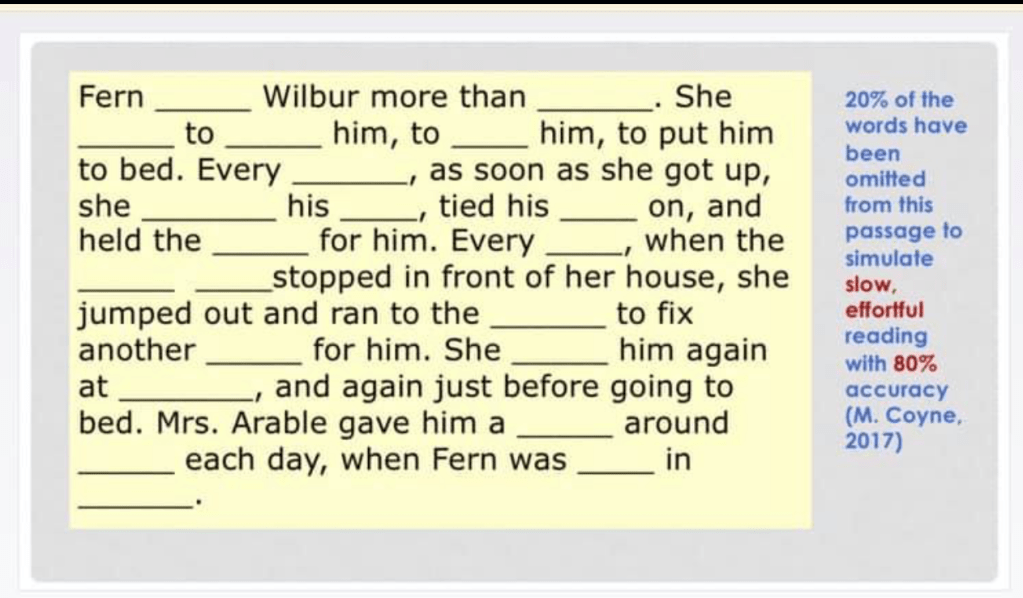
This example is from a presentation of Professor Michael Coyne from the University of Connecticut (Neuroscience of Reading conference).
Sit with this passage for a moment. Put yourself in the place of a student in middle school. In high school.
Imagine what it would be like to be in a classroom of 25 other students who all seem to be doing just fine, but here you sit. With a chapter to read (which will just be an extension of the picture above). With probably 10 questions to answer about the chapter. With maybe a written response you need to complete. Before the period ends.
And that is just one class period out of three if you are on block scheduling or six or seven otherwise.
Anxiety. Anger. Poor self-image/esteem. Depression. No wonder.
Social Problems
Children struggle with finding a peer group due to their poor self image. Dyslexia and other reading challenges manifest in communication barriers with peers. (Ah, and these also relate to what happens in classrooms, too.)
Speaking Hesitation: Children struggle with finding the right words, so they may pause while responding. Or, they may have a longer pause before answering a question. (Processing speed and working memory challenges)
Weak sequencing skills: Children may struggle to remember the order in which events happen, so trying to recall and/or convey how things happened is difficult. This challenge impacts interpersonal relationships (when a parent or teacher asks what happened in a disagreement or conflict). When playing sports, a child may struggle with remembering the ordering of skills or sequences (passing a ball in various sports, for example).
Task Inconsistencies: What others can do naturally, children with dyslexia and other reading challenges tax their working memory to the highest degree and are inconsistent in tasks. Others may see their work as careless and become frustrated with them which then intensifies the negative feelings in the child/ren.
Family Problems
A child with dyslexia tends to keep things together at school and then falls apart at home, causing significant stress on all household members. Whoever is the caretaker (responsible for education, health of the kids) tends to feel the brunt of the anger and stress from the child.
The parents and guardians are also frustrated because they have typically tried all they can to make things better (attention that the child who is struggling resents) and/or the parents/guardians don’t know how to get the help they need. Let’s face it — there really aren’t many people out there that know how to help in these situations.
How to Help
Here is a screenshot from the IDA article that provides 5 tips to help:
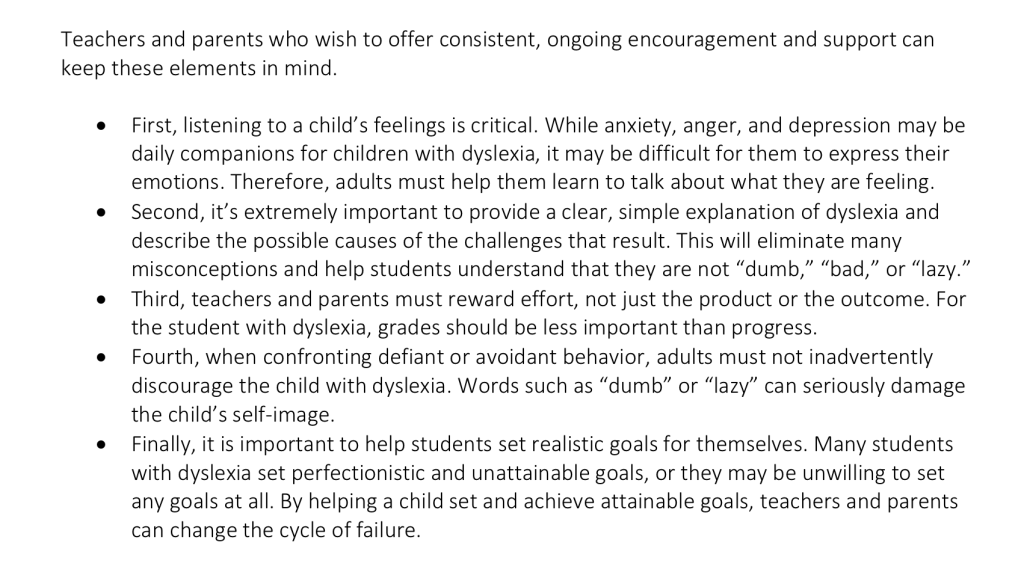
I can’t summarize this information any better. Frankly, these recommendations are “best practices” period.

